Welcome to the official website of Dongguan Tengtoo Aluminum Products Co. , Ltd. !
Official wechat | Site map



What is the difference between CNC machining and 3D printing
Author:TengtuCNC
Click:
Time:2026-04-22 14:41:57
What is the difference between CNC machining and 3D printing
In modern manufacturing, CNC machining and 3D printing are two core digital manufacturing technologies that can convert design models into solid parts through computer programs. However, there are essential differences in the processing logic, performance, and applicable scenarios between the two, and the selection needs to be accurately matched with production requirements. Below is a detailed explanation of the differential characteristics between the two from the five core dimensions.
1、 Core principle: subtractive manufacturing vs additive manufacturing
This is the fundamental difference between the two, which directly determines all subsequent performance differences.
CNC machining belongs to 'subtractive manufacturing', which uses a whole piece of material (metal block, plastic board, wood, etc.) as the processing base, and uses computer-controlled cutting tools (milling cutters, drills, turning tools, etc.) to perform cutting, drilling, boring and other operations, gradually removing excess materials and ultimately forming the target shape. The machining process relies on tool path planning, which requires simulating the tool motion trajectory in advance to avoid interference and is suitable for processing regular geometric shapes and complex surfaces.

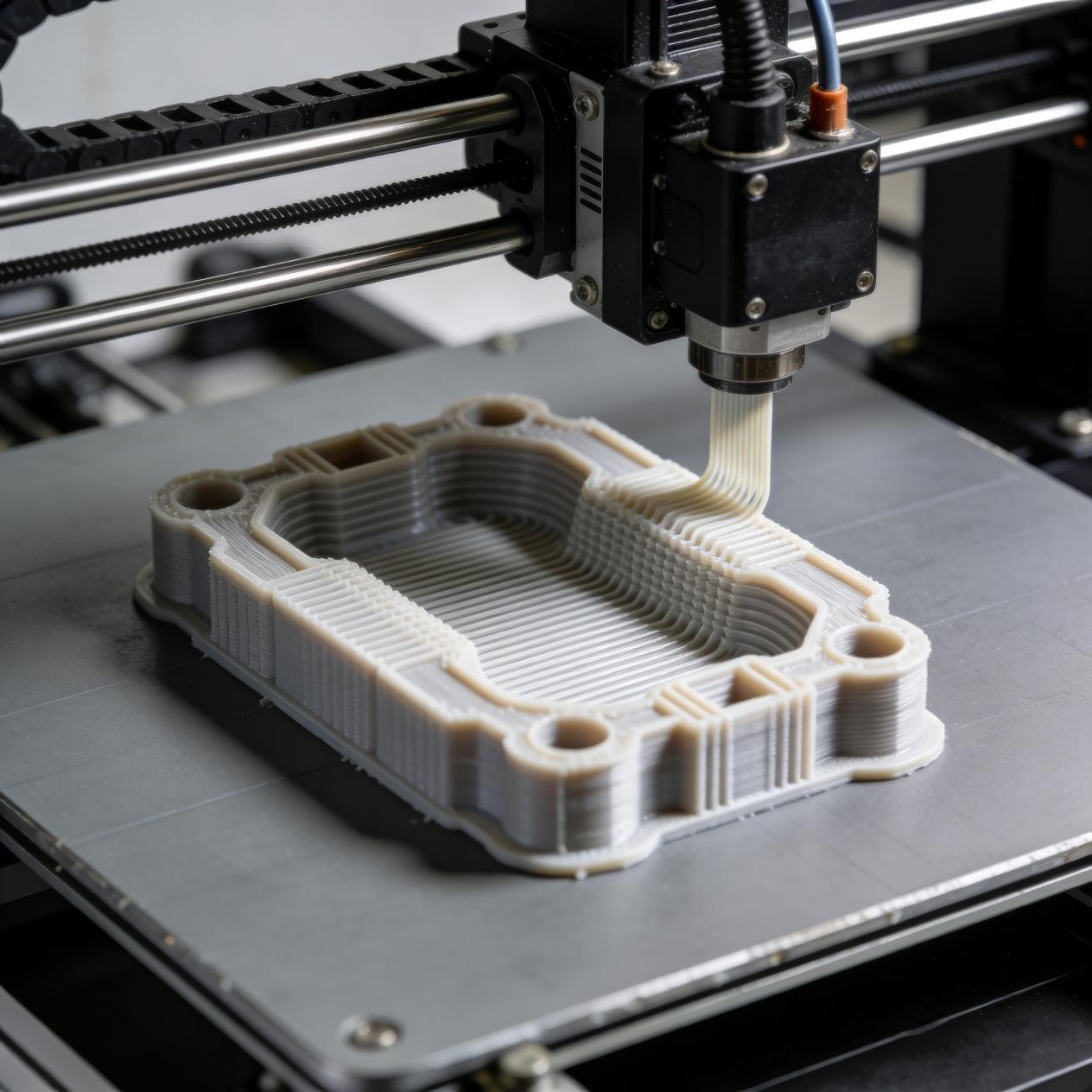
3D printing belongs to 'additive manufacturing' and follows the principle of 'layer by layer stacking'. Whether it is fused deposition modeling (FDM), laser sintering (SLS) or photopolymerization (SLA), they all start from scratch and build parts by stacking materials (resin, metal powder, plastic wire, etc.) in a layered manner, with each layer thickness precisely controlled at the micrometer level. This method does not require cutting tools and can break through the structural limitations of traditional machining, easily achieving special designs such as internal hollowing and complex lattices.
2、 Material adaptation: Range breadth and performance differences
The significant difference in material compatibility between the two directly affects the mechanical properties and application scenarios of the parts.
The range of CNC machining materials is extremely wide, covering metals (aluminum, steel, titanium alloys, copper, etc.), engineering plastics (ABS, nylon, etc.) POM)、 Wood, composite materials, and even stone. Especially in the field of metal processing, CNC can adapt to high-strength and high hardness materials, and the density of the processed parts is consistent with the raw materials, with stable mechanical properties. For example, Dongguan Tengtu Aluminum Products Co., Ltd. specializes in CNC machining of aluminum products, which can accurately control the strength and toughness of aluminum alloys and meet industrial grade requirements.
3D printing materials are mainly specialized consumables, adapted to different types of processes: FDM uses PLA and ABS plastic wires, SLA relies on photosensitive resins, and metal 3D printing requires specific metal powders (such as titanium powder and aluminum alloy powder). Although the types of materials have been expanding year by year, the range of options is still narrower than CNC, and the cost of metal 3D printing consumables is high, only suitable for high-end customization scenarios; Plastic printed parts have weak mechanical properties and are difficult to withstand high-strength loads
3、 Accuracy and Surface Quality: Controllability and Process Limitations
Accuracy and surface quality are the core requirements of industrial parts, and there is a significant gap between the two in this dimension.
CNC machining has extremely high precision, relying on precision machine tools and tool control. The tolerance level can reach IT5-IT8, and the surface roughness Ra value can be as low as 0.1 μ m. Some ultra precision machining can even achieve nanometer level accuracy. After processing, the surface of the parts is smooth and can be directly assembled and used without complex post-processing, especially suitable for metal parts that require high fitting accuracy, such as automotive engine cylinder blocks.
The accuracy of 3D printing is limited by the process and layer thickness. The conventional FDM process has a tolerance of around ± 0.1mm, while SLA accuracy can be improved to ± 0.05mm, but it is still inferior to CNC. Due to the layer by layer stacking characteristic, the surface of the parts is prone to leaving layer patterns, which need to be improved by post-processing such as polishing, polishing, and solidification to enhance the texture; Metal 3D printed parts may also have internal pores that affect structural stability and require additional hot isostatic pressing treatment.
4、 Efficiency and Cost: The Game of Batch and Complexity
The difference between efficiency and cost depends on production batch size, part complexity, and upfront investment, each with its own advantageous scenarios.
The cost and efficiency of CNC machining are positively correlated with batch production: small batch production requires the investment of cutting tools, fixtures, and programming time, resulting in higher unit costs; But when the batch reaches over a hundred pieces, the fixed costs are diluted and the efficiency advantage is highlighted - especially for simple structural parts, CNC can quickly cut and form, far exceeding the speed of 3D printing. In addition, although the utilization rate of CNC machining materials is lower than that of 3D printing (due to the presence of cutting waste), metal waste can be recycled and reused, reducing overall costs.
3D printing is more suitable for small batch and complex part production: no tool fixtures are required, programming is simple, and the cost of small batch scenarios with 1-10 pieces per batch is lower. For example, in the case of Mitsubishi Chemical's sorting wheel, the cost of 3D printing small batch parts is significantly lower than that of CNC machining. But as the batch size increases, the printing time will linearly increase with the number of parts, and the efficiency will significantly decrease; Moreover, the high price of specialized consumables further increases the cost of mass production. At the same time, 3D printing supports synchronous processing of multiple parts, and as long as it does not exceed the printing range, multiple different parts can be produced at once, improving the flexibility of small-scale production.
5、 Applicable scenarios: Functional requirements determine process selection
Based on the above differences, the application scenarios of the two form a clear division of labor, and some scenarios can complement each other.
CNC machining is suitable for: ① mass production of precision metal parts (such as aluminum products and stainless steel components); ② Industrial components with high requirements for strength, accuracy, and surface quality (such as medical devices and automotive parts); ③ Processing of structural components ranging from simple to moderately complex. For enterprises like Dongguan Tengtu Aluminum Products Co., Ltd., CNC machining is the core process to meet customers' bulk demand for industrial grade aluminum products and ensure product accuracy.
3D printing is suitable for: ① Prototype production in the product development stage (rapid iterative design, reducing transformation costs); ② Complex structural components (such as internal lattices, hollow shapes, and irregular parts); ③ Small batch customized production (such as personalized medical devices, cultural and creative products); ④ Difficult to machine inverted and deep cavity structural components through CNC machining.
Summary: Complementary rather than opposing manufacturing solutions
CNC machining and 3D printing are not in a competitive relationship, but complementary technologies that adapt to different needs - CNC machining has the core advantage of 'high precision, large batch, and metal adaptation' to support industrial scale production; 3D printing is characterized by 'high flexibility, complex structure, and small batch', empowering research and development innovation and customized needs. In actual production, some companies adopt the '3D printing prototype+CNC mass production' model, balancing research and development efficiency with production quality. When selecting, it is necessary to make a comprehensive judgment based on the material of the parts, precision requirements, production batch size, and cost budget, in order to maximize the value of the process.
Prev : Which is better, aviation aluminum or aluminum alloy? Next : Large scale CNC machining of aluminum alloy parts: solving efficiency, accuracy, and cost problems through process optimization
文章推荐
Why 6061-T6 is the Benchmark Material for CNC Machining
Why 5-Axis Linkage CNC Is Essential for High-Precision Parts Machining
Dongguan Tengtu Aluminum Products Co., Ltd. has introduced two brother U500XD2-5AX five axis CNC machining centers, taking precision manufacturing capabilities to a new level
What is CNC Machining? A Complete Guide to CNC Machines, Applications & Benefits
Analysis of the entire process of aluminum extrusion technology: from mold design to surface treatment
Large scale CNC machining of aluminum alloy parts: solving efficiency, accuracy, and cost problems through process optimization

Contact us

Dongguan Tongtoo Aluminum Products Co. , Ltd. NO:Guangdong ICP 19132491
Tel:0769-82655687 Fax:0769-82655697
Mobile phone:13827282979 Miss Xie Sales Manager:18925799998 Mr. Wang
Address:1st Floor, Building 4A, Fuchuangke Industrial Park, No. 9 Huangxinwei Road, Zhongtang Town, Dongguan City,Guang dong province, China
 Scan the code to ente
Copyright @ VillaGrandis All Rights Reserved ICP备案号180006020号-3
